New Research on the Outcomes of Healthcare Programs in Texas
By Riley Burr, Vice President of Policy and Research, CECU, and Executive Director, CECU Research Foundation
Dr. Adem Ekmekci of Rice University has released a new report, Outcomes of Allied Healthcare Education in Texas, which provides a systematic comparison of student outcomes in allied health certificate and associate degree programs offered by for-profit career colleges and public community colleges across Texas. This work serves as a foil to the traditional knowledge that for-profit colleges have “perceived” differences in institutional missions and functions compared to public colleges. Dr. Ekmekci, however, provides evidence that these for-profit institutions show a convergence with the missions of public colleges in recent decades and are providing results that show their value to students.
In this work, allied health programs include any program that falls under CIP code 51; Appendix A in the report provides a full list of professions included in the analysis, but key careers include medical/clinical assistants, licensed practical/vocational nurse training, registered nursing, and general health and wellness. Using administrative data from the Texas Higher Education Coordinating Board and wage records from the Texas Workforce Commission, the study evaluates two core dimensions of student success: program completion and post-completion economic mobility. By limiting the analysis to healthcare programs offered in both sectors, the report offers a careful “apples-to-apples” comparison of outcomes of different school types in a high-demand workforce field. By focusing on outcomes in Texas specifically, Dr. Ekmekci was able to go deeper than the traditional analysis using College Scorecard and IPEDS; Texas has one of the largest education databases in the world that connects student-level and school-level data to provide a valuable foundation for this work.
First, we look at the results for certificate programs in the analysis. Career college graduation rates for certificate programs are nearly double the graduation rate for community colleges (51.8 percent compared to 28.6 percent), which is complemented by quicker completion times as well. Career college students tend to graduate from their certificate programs in an average of .79 years (roughly 9.5 months) compared to the community college graduation timeline of 1.43 years (over 17 months). The higher graduation rate for career college students holds true across all racial/ethnic groups included in the analysis, particularly Hispanic students (58.6 percent graduation rate at career colleges compared to 28.4 percent at community colleges). Among both school types, women tend to graduate from certificate programs at a higher rate than men.
Looking at the graduation rates of associate degrees, the analysis showed that career colleges students graduate at over twice the rate of community colleges students (48.6 percent compared to 21.2 percent). Again, we see faster completion time at career colleges, with the time to graduation for career college students averaging 1.29 years (15.5 months) compared to an average completion time of 1.89 years (over 22 months) for community college students to graduate. Women tend to graduate from associate degree programs at a higher rate than men at both career colleges and community colleges. As was seen for certificate programs, career colleges show higher graduation rates for any racial/ethnic group included in the analysis compared to those at community colleges.
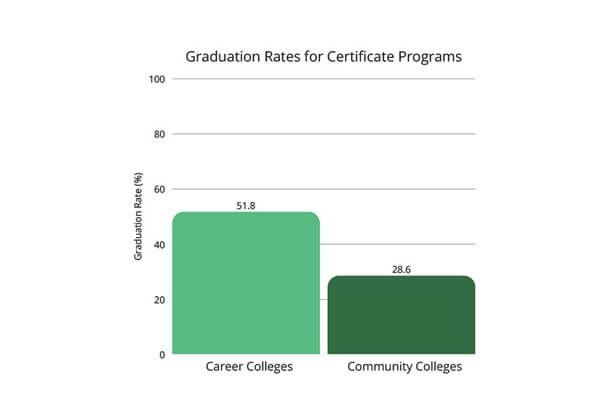
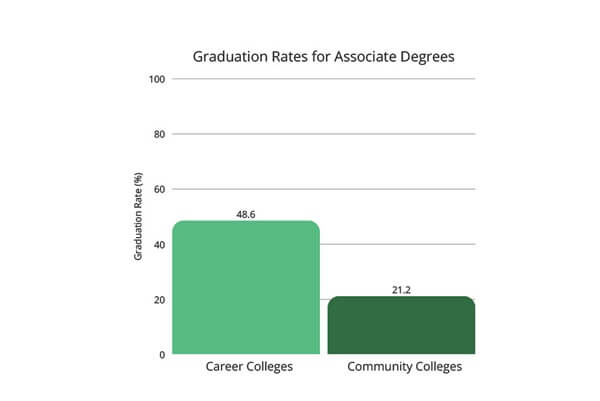
These graduation rates contribute to the pre-existing knowledge that career colleges have excellent graduation rates among certificate and associate degree programs. However, Dr. Ekmekci also explores the wage impact of these programs by comparing the pre-enrollment wage and the post-graduation wage of students at career colleges and community colleges. At healthcare certificate programs, mean and median wage impacts of career colleges are significantly higher than those at community colleges. The mean wage impact for career colleges is $8,704 for career colleges compared to $6,309 for community colleges. The median wage impact is $7,731 for career colleges compared to $4,630 for community colleges. Wage impact continues to be stronger at career colleges for the following subgroups: men, women, Hispanic students, Asian students, African American students, and White/Caucasian students. Significant differences were not seen for the other racial/ethnic groups evaluated.
Wage impact at career colleges is again stronger than that of community colleges for associate degree programs. Overall wage impact is $22,832 for career college students and $18,821 for community colleges students. Female students at career colleges have a particularly strong wage impact, over $3,000 higher than female students at community colleges. Wage gains are significantly higher for Hispanic students, Asian students, African American students, and international students. Significant differences were not observed for the other racial/ethnic groups evaluated.
Taken together, the completion and wage outcomes documented in Dr. Ekmekci’s analysis highlight the strengths of career colleges as an accelerated and effective pathway into the healthcare workforce. These institutions appear well-positioned to provide near-term relief to healthcare labor shortages in Texas while offering strong educational and economic outcomes for students—particularly those from populations historically underserved by traditional higher education pathways.
Dr. Ekmekci also contributes some recommendations based on his research, suggesting that state agencies should enhance their data systems to allow for comparisons across longer timeframes and more in-depth analyses. Further, they should standardize reporting of program-level outcomes to ensure ongoing apples-to-apples comparisons so that students can truly know what different programs will offer them in their educational pursuits.
A full description of the methodology, results, and recommendations can be found at by visiting Rice University’s School Mathematics Project webpage at https://rusmp.rice.edu/news/featured-stories/outcomes-allied-healthcare-education-texas.